An AI coach can produce a confident training recommendation even when the research behind it says little about the athlete asking. At Sports Brain AI, we are starting a review of who appears in sports science research and how clearly studies report their results. That question comes before deciding what an assistant should recommend to a young footballer, a tennis player or a national-level athlete.
The distinction matters. Counting female participants tells us about representation. It does not tell us that a training method works differently for women and men, or what any individual athlete should eat. Those questions need studies of the relevant outcomes.
More participants can still leave gaps
A 2014 audit by Joseph Costello and colleagues examined 1,382 articles in three major sports and exercise medicine journals. Female participants accounted for 39% of the 6,076,580 participant appearances they counted. Appearances are observations across reports, so the same person can contribute to more than one paper. The authors also reported different averages when they calculated representation at article level. A large database can therefore change the overall share without changing what a typical small experiment studies. Costello et al., 2014
Benjamin Ose and colleagues revisited the same three journals for January 2021 to August 2023. Their 2025 paper covered 1,441 studies. The reported female share was 43.95% across participant appearances, while the mean female share per study was 40.22%. These are two valid descriptions of the same corpus, answering different questions. Neither figure describes all sports research worldwide. Ose et al., 2025
Female participant appearances
Two audit periods in the same three journals
Types of study reports
Paul audit, 2023: 669 sport-specific reports
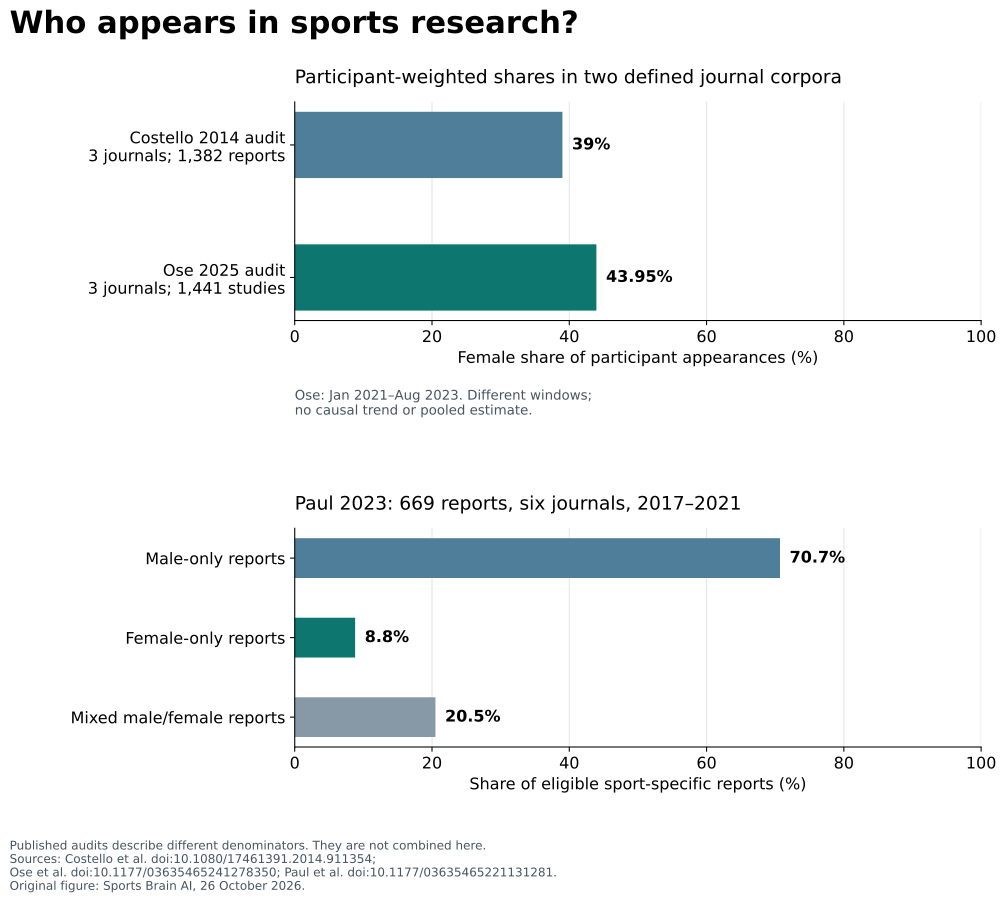
Read the chart data and denominators
| Audit | Measure | Reported share |
|---|---|---|
| Costello 2014 | Female participant appearances | 39% |
| Ose 2025 | Female participant appearances | 43.95% |
| Paul 2023 | Male-only reports | 70.7% |
| Paul 2023 | Female-only reports | 8.8% |
| Paul 2023 | Reports with both | 20.5% |
These are separate audit corpora. Their results have not been pooled. Participant appearances and report types are different denominators.
Ask what the paper actually tested
A study can recruit women and men, then report one combined average. That may answer its stated question, but the average alone cannot establish that the effect is the same in each group. A comparison of group-specific effects, with enough precision and an appropriate interaction analysis, is a different piece of evidence. A statistically significant result in one group and a nonsignificant result in another is not, by itself, proof that the groups differ. Cochrane Handbook, Chapter 10
Ryan Paul and colleagues used another lens. Their review selected 669 sport-specific studies from six sports medicine journals for 2017–2021. It reported that 70.7% studied male athletes only, 8.8% female athletes only, and 20.5% both. This narrower question exposes a different part of the evidence base. Comparing its 8.8% directly with Ose's 43.95% would confuse the percentage of papers with the percentage of participants. Paul et al., 2023
What this means for Caribbean coaching
For a Jamaican school team, the useful question is whether the study resembles the athletes and conditions in front of the coach. Check the sport, age, competition level, training history and setting. A finding from adult professionals should not silently become a prescription for adolescents. Differences in coaching support or access to food can also limit how a recommendation transfers; their effects need to be measured rather than assumed.
Stacey Emmonds and colleagues describe why applying research in women's sport requires attention to both the athlete and the sporting environment. That is a useful starting point for our regional work. It does not supply an estimate of how much any Caribbean team will improve. Emmonds et al., 2019
Our review will preserve the terms each study used for sex and gender, record how those categories were measured, and keep missing information visible. The SAGER guidelines explain why these constructs should be reported carefully. We will not infer a person's gender from a name or photograph, or treat nationality as a nutritional requirement. Heidari et al., 2016
The review Sports Brain AI is preparing
The first stage is a defined journal audit, followed by an evidence map. We will record who was recruited, whether category counts add up, and whether mixed-group studies report useful group-specific results. Existing reviews can cover some of the same original studies, so adding their totals together would count evidence more than once.
The protocol is drafted. Formal screening, independent extraction and any justified statistical synthesis remain to be done. We will publish those stages as they happen. A meta-analysis will be reported only if compatible, non-duplicated data support one; an attractive chart cannot supply that evidence.
Coaches can make a useful start this week. Choose five research-based recommendations you currently use. For each, record the study population and the outcome it measured, then identify one place where its applicability to your athletes is uncertain. Keep those gaps with the recommendation. That gives an assistant coach something more useful than confidence alone: a record of what supports its advice and what a qualified coach or practitioner still needs to check.
Sources and research notes
- Costello et al., 2014
Inspected abstract-level evidence for the three journal audits; see protocol source ledger for access and methodological limits. - Ose et al., 2025
Inspected abstract-level evidence for the three journal audits; see protocol source ledger for access and methodological limits. - Cochrane Handbook, Chapter 10
Method/source inspected in the accompanying research protocol. - Paul et al., 2023
Inspected abstract-level evidence for the three journal audits; see protocol source ledger for access and methodological limits. - Emmonds et al., 2019
Method/source inspected in the accompanying research protocol. - Heidari et al., 2016
Method/source inspected in the accompanying research protocol.
Company milestones are reported by the company. External study findings retain their original population and comparison. This article was prepared with AI assistance and checked against the cited material.