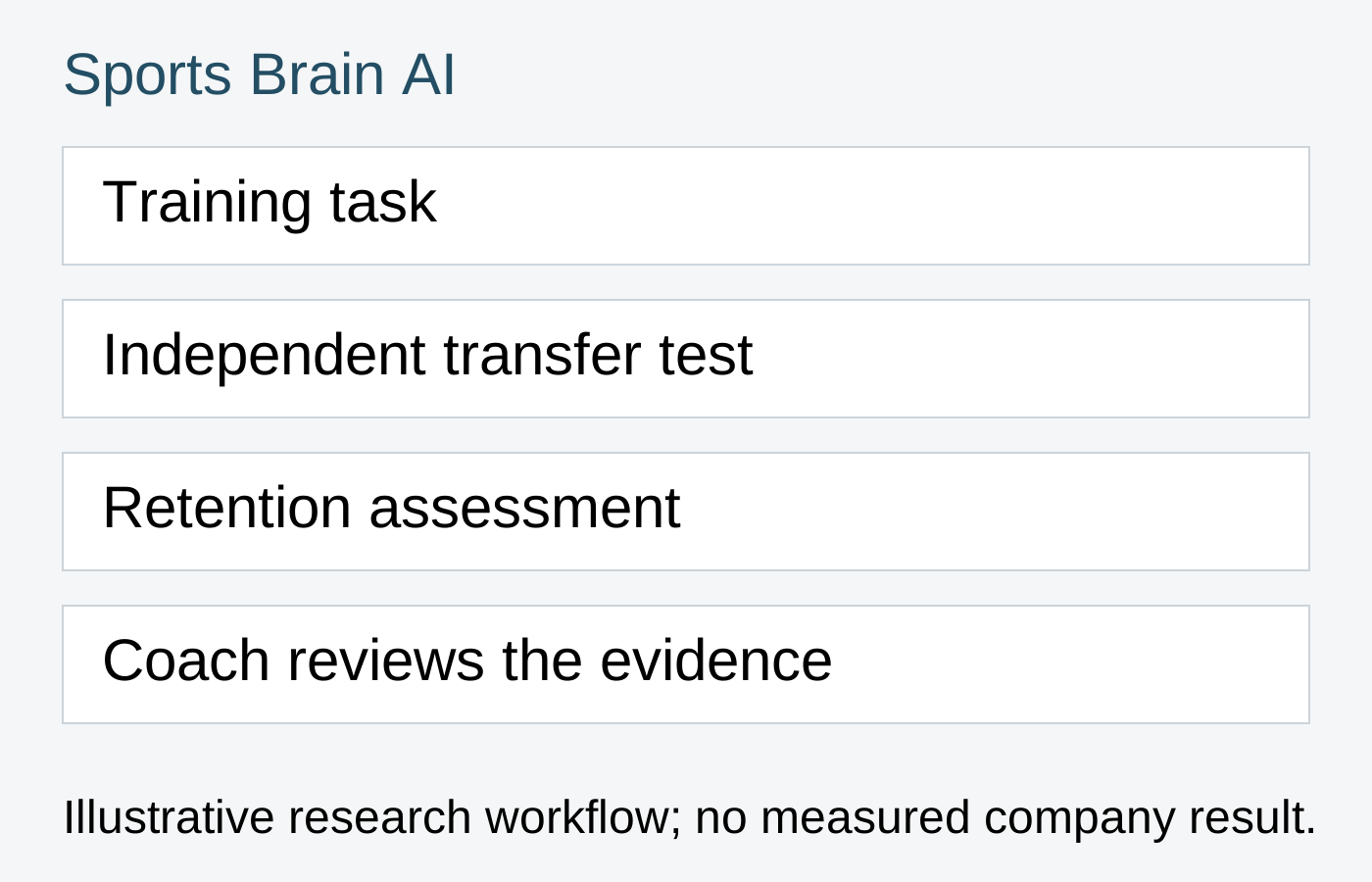
A quicker response to a training screen is useful evidence about that task. Before using it to recommend a training programme, a coach needs to know whether the improvement carries into the decisions an athlete makes during play. For Sports Brain AI, this is the distinction that should shape reaction-time research and an assistant coach's advice.
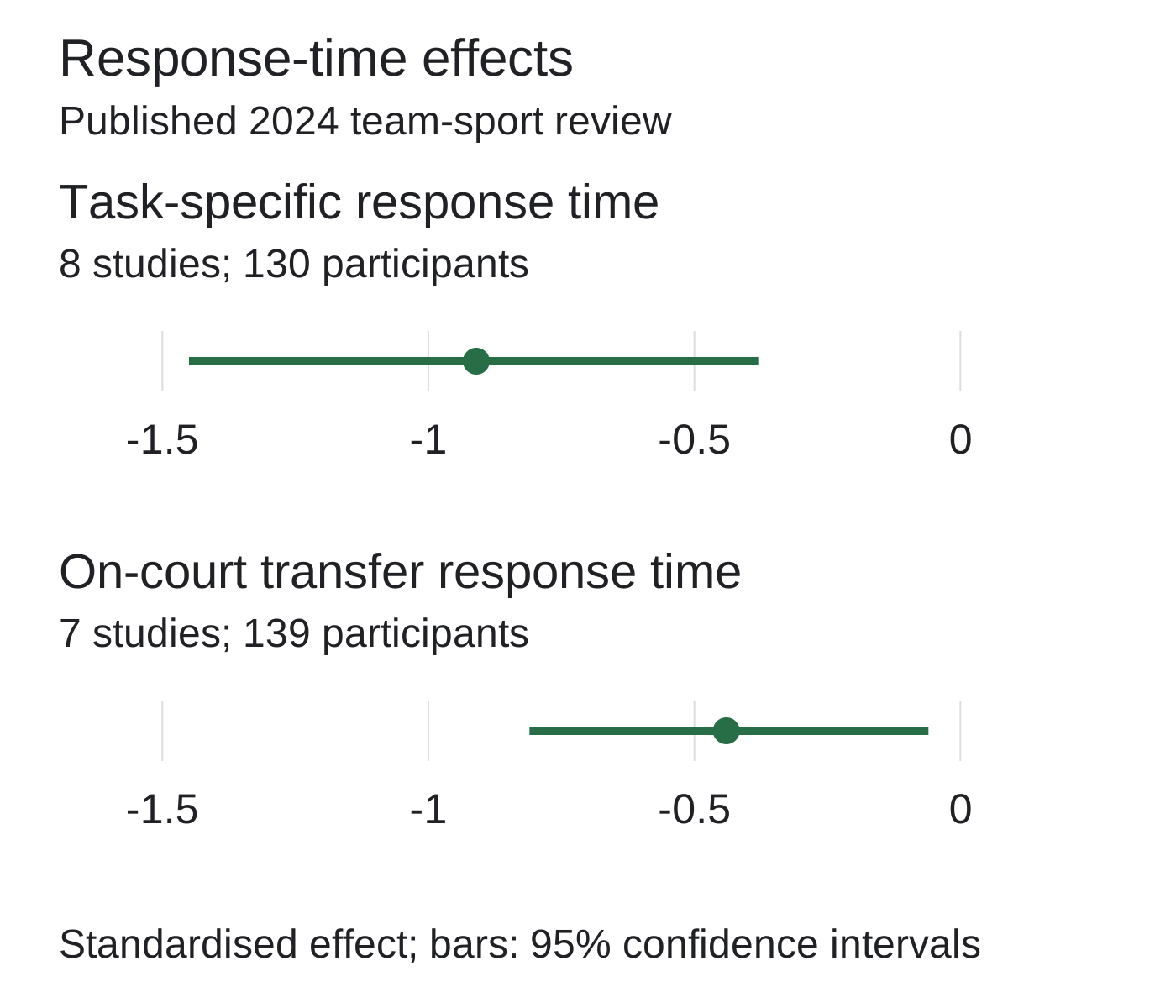
A published 2024 systematic review separates laboratory outcomes from on-court transfer. Its response-time analyses reported a standardised effect of −0.91 for task-specific tests and −0.44 for transfer tests. Negative values favour faster responses. The respective 95% confidence intervals were −1.45 to −0.38 and −0.81 to −0.06; the analyses included 8 studies with 130 participants and 7 studies with 139 participants. These are the review authors' pooled estimates, not new Sports Brain results.
What you can compare
The accompanying chart preserves those separate study sets. It does not subtract the estimates, calculate a percentage loss of benefit or establish that every athlete experiences a smaller effect on court. The review reported different heterogeneity for the two response-time outcomes: I² of 48.0% and 13.8%. Pooling them again would require the underlying study data and a defensible treatment of overlap.
The review’s stated eligibility criteria specify elite team-sport athletes with more than three years of experience. Its outcomes concern anticipation and decision-making interventions. It does not establish that a generic light-board drill improves tennis match outcomes, that one device is best, or that faster responses alone improve selection prospects. Our youth-development review addresses the separate question of what a performance measure can predict.
Match the test to the decision
For a proposed football study, define the decision before selecting equipment. Reacting to a light, identifying a passing option in a video and choosing a pass while moving under pressure demand different information and actions. Your test should state which of those tasks the training is intended to improve.
Keep the response definition precise. The interval from stimulus onset to a button press includes a particular device and action. A field measure may include recognising the cue, choosing a direction and moving. Calling both reaction time can hide the mechanism the coach needs to understand. Retain the units, trigger, response rule and recording method with every result.
A repeated screen test may also reward familiarity with the test itself. Use an appropriate comparison activity and give both groups comparable contact time where feasible. Retain separate practice and evaluation materials. If the same clips are used for training and assessment, an improved score cannot resolve whether the athlete learned a transferable skill or remembered the examples.
What an assistant coach should retrieve
A proposed assistant could retrieve the training task, tested population, comparison activity, outcome and follow-up period before drafting a recommendation. It should keep a laboratory response measure separate from a sport-specific action. An attractive interface or an annotated match video cannot supply the missing transfer evidence.
For computer-vision work, agree how a human reviewer will identify the event and check disagreements before timing it automatically. A system that marks the wrong stimulus onset can produce a precise-looking interval for the wrong event. Retain uncertain annotations and report missing footage rather than removing difficult examples after viewing the result.
Check retention and opportunity
Assess whether an improvement remains after training ends. A result immediately after the final session answers a different question from a later retention test. Record other coaching and practice during follow-up so your interpretation does not silently assign all change to the tested activity.
Include access to coaching, equipment and practice when describing the study population. These conditions affect who can participate and how the intervention is delivered. Record sex and gender as distinct variables where relevant and ethically collected; describe representation without inferring biological requirements from group averages. A review's mixed sample cannot establish the same response in every sport or group.
What you will test next
Before recruiting athletes, a Sports Brain study team could prepare a task map by 6 November 2026. This is a proposed protocol-development checkpoint, not an executed trial.
- Write one training target and one sport-specific transfer outcome. Specify the cue, response, units and recording method.
- Audit 10 permitted example clips for whether independent reviewers can identify the same onset and response. Record disagreements and missing information; this count is a documentation target, not a validation sample.
- Choose the comparison activity, later retention window and permitted data before assessing outcomes. Seek appropriate consent and qualified oversight for youth participation.
The strongest limit is transfer to the intended athlete and sport. The inspected review supplies a reason to measure it directly, while leaving the local effect unresolved. This focused narrative interpretation reports an existing meta-analysis; it does not execute a new one. Sports Brain's separate male/female review protocol remains unregistered and unexecuted.
Sources and review scope
- Zhu et al., 2024, section 3.3 and Figure 3. Full text inspected; separate response-time estimates, confidence intervals, samples and heterogeneity; no new pooling.
Focused narrative methods explainer, checked 30 October 2026. Sources selected through targeted primary-source searches; no exhaustive screening, new meta-analysis or company experiment was performed. Proposed tests remain unexecuted. Prepared with AI assistance and editorial source checks.
More from Sports Brain AI. Add this site as a preferred source on Google.