
A coach pricing food for a training week needs two figures. The first is what the team must pay at the shop. The second is the cost of the food the team actually serves that week. A bag of rice left in the cupboard may help next week’s budget. It still has to be paid for this week.
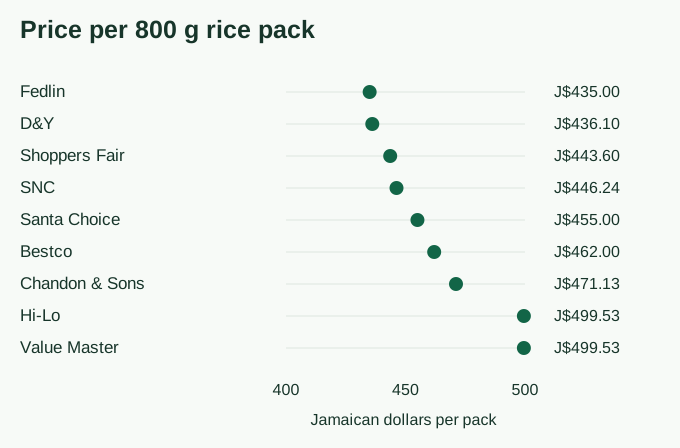
The October grocery survey from Jamaica’s Consumer Affairs Commission shows why a single price can mislead. Nine surveyed outlets in Westmoreland and St Elizabeth listed the same Grace 800 g long-grain rice pack. The posted prices ranged from J$435.00 to J$499.53, a difference of J$64.53 per pack. The comparison holds the item and pack size fixed. It says nothing about which shop a team can reach. See the survey and price data.
Price the same pack before comparing shops
The chart uses every listed price in the survey’s Westmoreland and St Elizabeth table for that product. Each mark represents one outlet observation from 7–8 October 2026. The figures are a price snapshot, not a current quote or a representative sample of Jamaica. A buyer should confirm price, stock and pack size before ordering.
A lower shelf price can lose its advantage when a volunteer makes a separate trip to collect it. Record the transport cost when it changes with the shop. A club that already buys from an outlet on its usual route has a different choice from a school paying for an extra delivery. Keep that difference visible instead of assigning every team the same access to the cheapest pack.
Separate what you buy from what you serve
Start with the meals the team has agreed to provide, the sessions they cover and who can prepare them. Record the pack size and the portion as separate quantities. When a recipe uses cooked weights, weigh a trial batch and record the usable cooked yield. Then use that yield to estimate how many packs are needed. Comparing dry grams in a bag with cooked grams on a plate skips a conversion.
Keep a cash column for whole packs, delivery and preparation costs. Use a second column for the ingredients used during the covered sessions and record stock left for the next week. Price ingredients taken from opening stock at what the club paid for them. To compare cost per meal, divide the cost of the ingredients used, preparation and delivery by meals actually served. If the price of a delivered meal includes preparation and transport, compare it with the corresponding total for cooking, not just the shelf price of ingredients.
Set the menu constraints before looking for a lower price
A shopping list can be cheaper and still be unusable. Ask the person responsible for the menu to identify the substitutions they can approve, including constraints for allergies and access to storage. Check that athletes can collect the food when it is served. At a competition, a meal available after the team leaves has no value for that session.
The Tokyo Olympic and Paralympic food-provision evaluation gives an example of why availability is a separate question. Sports dietitians assessed menus in advance and visited dining facilities during the Games. They reported gaps in some snack options, some special-diet choices and accessibility. Some visually impaired athletes had difficulty reading menu labels. The event study did not price a Jamaican club’s menu. It helps identify what a price audit would miss.
Try the budget on one training week
Choose a week whose sessions and headcount the club already knows. Ask one person to obtain quotes and another to record meals served, leftover stock and any substitutions. Compare what the club expected to spend with the receipt total, then identify which ingredient, delivery charge or portion assumption explains the largest difference. Use those records to set the next budget.
Sports Brain AI’s earlier nutrition price update described preliminary work. This article offers a procurement test and analyses one external price series. It reports no Sports Brain meal-plan trial, athlete cost estimate or performance outcome.
Sources and data
- Jamaica Consumer Affairs Commission, Survey of Grocery Items, 7–8 October 2026. Page 1, Westmoreland and St Elizabeth, Grace 800 g long-grain rice row.
- Pelly et al., Sports Dietitians Evaluation of Food Provision for Athletes at the Tokyo 2020 Olympic and Paralympic Games. Cross-sectional event evaluation, published 2025.
More research from Sports Brain AI. Add this site as a preferred source on Google.