A coach reviewing match footage needs to know which player made a movement, where it happened and whether the camera captured enough of the play to interpret it. A computer-vision system can help organise that evidence. Its first job is to keep the measurement attached to the right person.
This Sports Brain AI research explainer examines player tracking and a proposed route from video to a coach's review. It follows our reaction-time article, which addressed a different question: whether a training improvement transfers into play. No new Sports Brain model result or athlete evaluation is reported here.
Follow the same player through the clip
Detection locates a player in an individual frame, commonly with a rectangular bounding box. Tracking adds identity across frames. If two players cross and the system swaps their labels, a later summary can assign one person's movement to someone else. A neat-looking trajectory does not expose that mistake unless the reviewer checks the underlying footage.
The SoccerNet tracking benchmark makes an important distinction. An association-only task starts with supplied reference detections; a complete tracking task must also detect objects in the video. The first tests how the system connects observations. The second includes errors from finding them. A supplier's result needs to identify which task was evaluated before a coach can interpret it.
SoccerNet uses Higher Order Tracking Accuracy, or HOTA, with components for detection and association. The original HOTA paper explains why evaluating tracking requires attention to different error types. A single score can aid comparison, but the component failures matter when deciding what a tool can support.
Read the dataset before the leaderboard
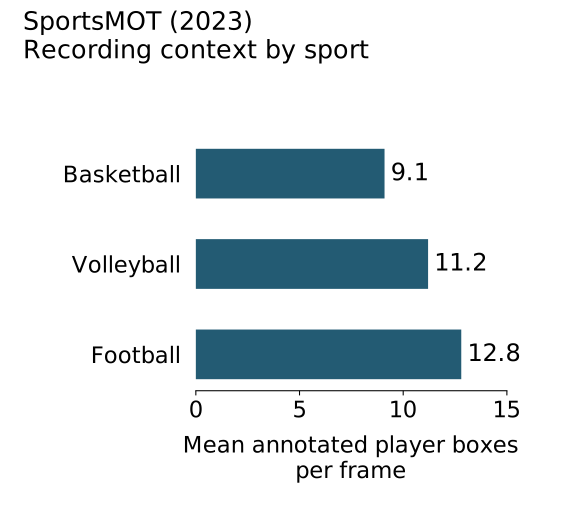
The 2023 SportsMOT paper describes 240 video sequences across basketball, volleyball and football. Its selected overhead footage excludes abrupt viewpoint switches. That construction is useful for its stated tracking task; it does not reproduce every recording a school or community coach might use.
The chart transcribes the paper's average annotated player boxes per frame by sport. These are dataset characteristics, not accuracy results, unique participant counts or evidence that one sport is inherently easier to analyse. Publication year identifies the paper; the chart does not assign an unreported collection year to the footage.
For a Caribbean school programme, recording conditions therefore belong in the evaluation. A fixed elevated camera, a handheld phone and a drone can present different views of the same game. Test the setup that the programme can obtain and maintain. An inaccessible camera arrangement is a deployment constraint even if a model performs well on footage collected elsewhere.
Separate movement from tactical judgement
A coach asking whether a passing opportunity existed needs more than a sequence of player boxes. The evaluation must define the opportunity: which player could act, which teammates and opponents were visible, what counted as a feasible action and when the opportunity ended. A ball outside the frame or an obscured defender can leave the question unresolved.
For a proposed study, ask coaches to annotate that decision independently before comparing the model with them. Retain disagreements. If reviewers apply different definitions of an opportunity, an apparent model error may reveal an unresolved label rather than a useful test of tactical reasoning. Agreement among reviewers still would not establish that the recommended action improves match outcomes.
A tracking evaluation should keep those stages distinct. Locate players, preserve identity, identify the event and then assess the proposed coaching use. Each stage can fail in a different way. This proposed sequence helps a team locate the fault instead of treating a fluent match summary as evidence that the earlier measurements were correct.
Make the assistant show its evidence
A proposed AI assistant coach could retrieve the relevant clip, its timestamps and any uncertain annotations before drafting an observation. The human coach should be able to return to the footage and correct the record. If a player leaves the camera view, the assistant should preserve that gap rather than produce an uninterrupted account of unseen movement.
Keep video coordinates distinct from physical distance. A path measured in image pixels needs an appropriate camera-to-pitch mapping before it becomes a distance in metres. Camera motion can otherwise be mistaken for player movement. The proposed evaluation should check the mapping and its error separately from the tracker, using the actual recording setup.
Research on one task should also remain attached to its population. Our male and female evidence review distinguishes representation, study design, sex, gender and sport-specific outcomes. A video dataset's size cannot establish that a tool has been evaluated across those groups. Record who and what the permitted evaluation covers; do not infer biological requirements or individual ability from group averages.
Build a local test before making a coaching claim
Sports Brain's inspected April 2026 research proposal identifies video analysis and assistant coaching as research directions. It does not supply a completed local tracking validation. The following is an editorial evaluation proposal, not a report that a trial has taken place or that an institutional partnership has been signed.
- Define one intended use, such as finding clips of a specified movement for a coach to review. Fix the annotation rules, recording setup and acceptable failure behaviour before assessing the model.
- With appropriate permission, assemble footage from different matches and recording conditions. Keep entire matches separate between development and testing so that nearby frames do not appear on both sides of the evaluation.
- Have independent reviewers check player identities and event labels. Record missed detections, identity swaps, camera cuts and unobservable events against the actual evaluated material.
- Evaluate the coaching task separately: whether the retrieved clip answers the question, how much correction the coach performs and which situations require manual review. A tracking score alone cannot answer that question.
Youth footage requires an authorised purpose, appropriate consent and restricted access. Use local study identifiers rather than publishing identities, and retain a route to correct annotations. A model should not become a selection or health recommendation system merely because it can draw boxes around a player.
The next useful result would be a documented evaluation on the recording conditions and coaching task the programme intends to use. Until that exists, benchmark findings can guide the test design while local usefulness remains an open question.
Sources and research status
- Cui et al., SportsMOT: A Large Multi-Object Tracking Dataset in Multiple Sports Scenes, ICCV 2023, sections 3.1–3.2 and Table 2. Full text inspected.
- SoccerNet tracking task documentation: association-only and complete-tracking tasks, objects and evaluation metric. Current page inspected 3 November 2026.
- Luiten et al., HOTA: A Higher Order Metric for Evaluating Multi-Object Tracking, arXiv version 2, 2020. Abstract inspected; used only for its stated evaluation rationale, not an empirical coaching outcome.
Focused narrative research explainer based on targeted primary-source searches for sports player tracking, benchmark construction and evaluation. Sources were selected for their relevance to those tasks; no exhaustive screening or new meta-analysis was performed. Sports Brain's separate representation-review protocol remains unregistered and unexecuted. The company proposal is dated internal evidence, summarised without redistributing its confidential contents. Prepared with AI assistance and documented editorial source checks.
More from Sports Brain AI. Add this site as a preferred source on Google.