
A coach can see who showed up for Saturday practice. To find out who could not get there, the club needs to follow up with families who missed the session and record what happened before the coach took attendance. A low turnout could start with an invitation that never got through, a bus route that stops too far away or a fee a family did not expect.
What participation surveys can tell a club
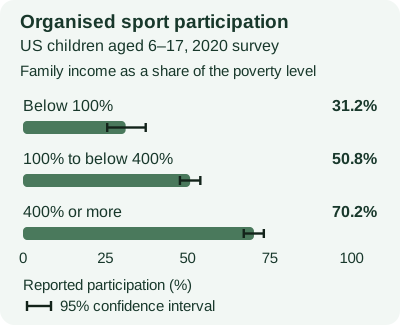
In the 2020 US National Health Interview Survey, a parent or guardian reported whether a child aged 6 to 17 had played on a team or club or taken sports lessons in the previous 12 months. Organised sport participation was lower in families below the US federal poverty threshold than in those at four times the threshold or higher. The survey provides national estimates within each income band. It cannot say whether the child had regular access to a coach, or at what stage access broke down for another child. The 12-month recall period could include time before and during the COVID-19 pandemic, so the survey cannot isolate the effects of restrictions.
A separate study by Pooja Tandon and colleagues asked students in grades five to twelve in King County, Washington, about their own experiences. Among respondents who had stopped or never played organised sport, those in the lowest family affluence category reported transport and cost barriers more often than those in the highest. The survey used a short household-assets questionnaire to group children. It measured perceived barriers at one point in time and cannot show whether a travel subsidy would improve turnout in Jamaica. It gives clubs two specific questions to ask families who rarely appear in their registers.
Find the point where participation drops
For one intake, ask the programme coordinator to keep a list of unique children the club tried to invite. Mark receipt as confirmed when a family replies or a school contact checks it with them. Distinguish a known failed delivery from a case where receipt is unknown. Record the intake start date. Among the confirmed invitees, count first visits to a coached practice in the first two weeks of the intake. For those first visitors, record who returns within their next two scheduled practices. Skip cancelled practices and wait until each child has had both chances. Keep walk-ins in a separate count throughout.
Ask families who missed the session whether they could get to the training site at the scheduled time and whether fees or equipment costs affected their choice. Make both questions optional. Let families describe other barriers in their own words. Leave the reason unknown when a family cannot be reached or chooses to skip the questions. Keep names and contact details within the club and combine or suppress small groups in reports where children could be identified. Use the counts to choose what to change about the programme. Keep a child's sporting eligibility independent of whether the family answers.
Suppose the club tries to invite 24 children. It confirms receipt for 20, of whom 12 attend in the first two weeks. Six of the 12 come back within their next two practices. Record those three steps as 20 of 24, 12 of 20 and six of 12. If the coordinator hears about the same transport problem from several households, the club could move its next session to a site on a bus route or trial a shared pick-up point. Change one condition, document any changes in coach or timetable and apply the same start-date rule and attendance windows to the next intake. Report how many first visitors return within their two opportunities in each intake. A difference can tell the club whether the change is worth testing again. Families, coaches and schedules may also have changed, so a comparison alone cannot attribute a difference to transport.
Separate attendance from assessment
When a school or club uses a performance test, attach the number of coached sessions available before the test and how many the child could attend. That record lets a coach distinguish a low score observed after steady practice from a score recorded when a learner had little time to practise. Mark an absent assessment as missing. A coordinator can offer a later, comparable assessment before using the first round to allocate places.
Sources and related research
- National Center for Health Statistics. Organised sports participation in the 2020 National Health Interview Survey (2022), definition, methods and Figure 3.
- NCHS. Figure 3 data and intervals.
- Tandon and colleagues. Socioeconomic Inequities in Youth Participation in Physical Activity and Sports (2021), sections 2 and 3, Table 3.
- Youth athlete prediction must account for opportunity.