A basketball coach evaluating an AI feedback assistant should ask players to take a set of free throws after the cues have stopped. Scoring the next practice block tells the coach how players perform while they receive help. A later test without cues answers a different question about what they can still do on their own.
A basketball trial found an advantage after feedback stopped
In a 2026 trial by Jiehao Dong and Zhen Zhang, 240 university students aged 18 to 24 were randomly assigned to two feedback packages during an eight-week university basketball unit. None had formal competitive basketball training in the previous three years. Both groups practised the same skill on the same schedule. One group received structured written feedback generated by an AI system from recorded performance observations. The other received oral corrections from an instructor. Students took 30 free throws without technical feedback at each assessment. Independent raters scored video of their technique without knowing which group a student belonged to.
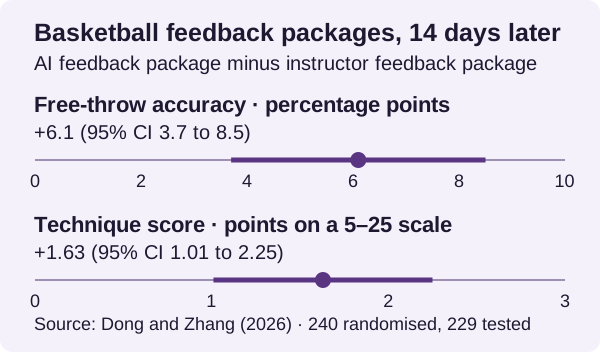
Fourteen days after the immediate post-test, 229 students completed the delayed test. The analysis retained all 240 students in their assigned groups. The adjusted estimate for shooting accuracy was 6.1 percentage points higher for the AI-feedback package. The adjusted technique score was 1.63 points higher on a 5–25 scale. The estimates compare the groups at that later test, accounting for baseline. The study found no clear difference in how much the groups’ scores fell from the immediate post-test to day 14.
People supplied the observations behind the cues
Basketball-trained research assistants counted makes and scored five parts of the movement, including alignment and follow-through. The system turned those records into a written cue and an observable target for the next block. Students also stated what they intended to try. The comparison bundled those features together, including a change from oral to written feedback. The paper therefore supports a comparison between two packages. An evaluation of the AI component alone would need the same rubric, written format and reflection step in both groups, with only the source of the draft changed.
The trial lacked prospective registration and measured the same free-throw task over a two-week follow-up. It leaves open how much carries over to match play or a different group of athletes. For a youth programme, an immediate question about motivation can help assess the session experience. A Norwegian youth football study used that approach to assess feedback from a coach. A delayed skill test serves a different purpose.
Test one cue before changing a coaching programme
Start with a single skill and a short observation form. For free throws, record makes and attempts and define one technique feature an observer can score consistently, such as whether the player holds the follow-through. Ask the assistant to draft one cue that names the recorded observation and gives the player a clear action. The coach checks the note against the observation, fixes unsupported wording and decides whether to deliver it.
To compare feedback sources, give players in both groups the same amount of practice and the same written format. Have one group receive a coach’s draft and the other a coach-checked assistant draft. Keep the testing conditions steady and score the same task at baseline, after practice and on a date when players receive no cue. Record how many players return for that later test and the time coaches spend correcting drafts. For youth sessions, use coded records and keep identifiable footage out of the drafting tool.
A club can then decide whether the workflow earns a second test. If athletes receive accurate cues more efficiently and retain the skill, test the next question separately, such as whether the cue transfers to a pressure drill. If the assistant repeatedly adds details the coach did not observe, pause it and check the input or instructions. This is a proposed evaluation for coaches. The university results come from the authors’ study, outside Sports Brain AI.
Sources and related research
- Dong and Zhang (2026), university basketball feedback trial. See methods sections 3.1–3.8 and results sections 4.1 and 4.6.
- Effects of coaches’ feedback on psychological outcomes in youth football. A crossover experiment on immediate self-reported outcomes.
- What player tracking can tell a coach. How to test the measurements that feed a coaching decision.
More research from Sports Brain AI. Add this site as a preferred source on Google.