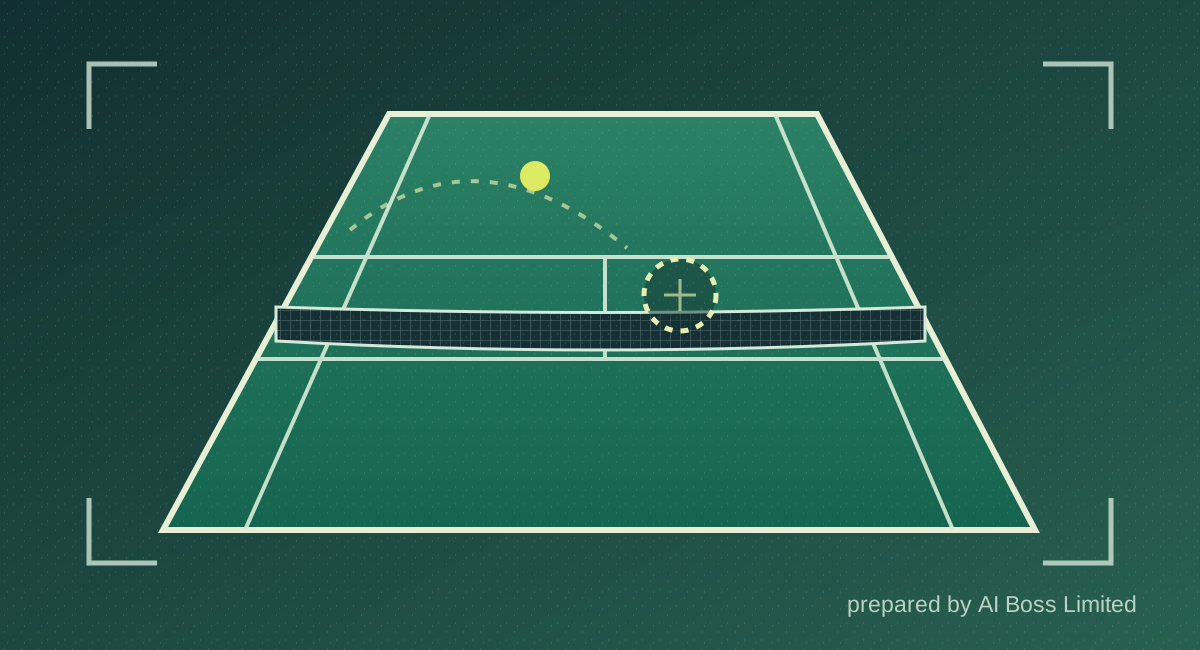
Ask for the rally before you change a player’s drill. If your video assistant says the player returned short serves down the middle, it should show you the clips and flag any landing the footage cannot confirm.
The ball can disappear where the decision matters
A ball tracker locates the ball in the picture. TrackNet, a 2019 study by Yu-Chuan Huang and colleagues, used consecutive frames to help locate a small, fast ball. The researchers labelled frames from the broadcast of the 2017 Summer Universiade men’s singles final. They randomly split frames from that match into training and test sets. The same camera and adjacent frames could appear in both sets.
The result depended on what the camera could see. The model matched the label in most easy-to-see frames and in one of seven frames where something blocked the view. The researchers estimated those blocked positions from neighbouring frames. That subgroup is too small to predict performance on your club’s camera.
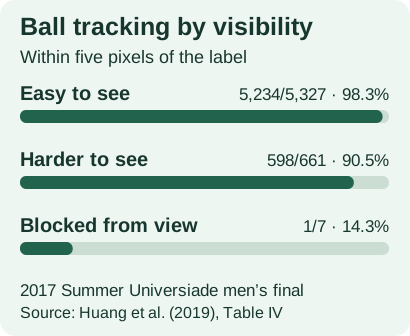
These are frame-level counts. A club deciding where returns land needs to check an event: the first bounce after the return. A tracker can follow most of a rally and still lose the ball at that instant. An overall score can hide this failure because most frames do not contain the bounce.
The March 2026 TennisExpert preprint by Zhaoyu Liu and colleagues goes further, combining detected shots, bounces, scores and player positions to produce commentary. Its benchmark uses professional match recordings. You still need to know what your own camera can support before you act on its advice.
Keep the rally and mark the bounce unknown
Imagine you set up your camera behind the baseline. A player returns serve and blocks the camera as the ball lands. The assistant draws a smooth path and labels the return deep. You can still use the clip to check where the player stood before contact. Mark the landing zone unknown. Count unknowns separately so you can tell how much of the session your depth summary covers.
Check one practice question before buying a video tool
Use footage you have permission to record and process. Keep identifiable youth footage out of unapproved upload services. Draw the landing zones you want to compare on a court plan, then pick one practice block. Have a coach mark each return and its first bounce before reading the assistant’s report. For each return, save the time in the clip, the first-bounce zone or an unknown flag, and the frame that supports the mark. Line calls need a separate test.
Compare the two records for missed returns, added events and zone disagreements. Ask a second coach to replay disputed clips. Check where the unknown landings cluster. You might find that late-afternoon glare hides the far end of the court. Move your camera and film another block before using that pattern to change a drill.
Finish with a checked rally list. If the evidence supports it, choose one practice change to try. Ask the vendor to export your corrections and unknowns, tell you who can see the footage, and show you how to delete it. Check whether the vendor uses your footage for training. Sports Brain AI has yet to carry out the club evaluation proposed here.
Sources and related research
- Huang and colleagues (2019), TrackNet, conference publication. Open full text, Sections III and V, Table IV.
- Liu and colleagues (2026), TennisExpert. Preprint, version 2, revised 17 March 2026. This article uses the benchmark’s stated scope and system description.
- What player tracking can tell a coach. A related Sports Brain AI explainer on checking the measurements behind a tactical decision.
More research from Sports Brain AI. Add this site as a preferred source on Google.